Surveying melon weeds in Central Australia
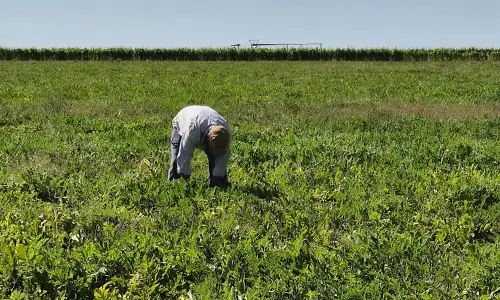
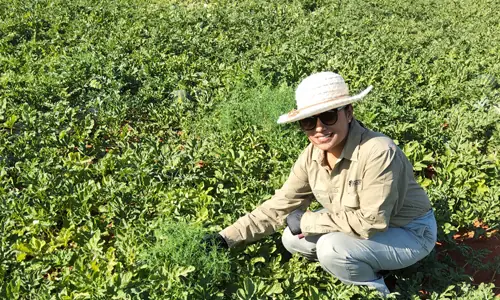
Dakshina Yadav and Shah Nawaz visited Desert Farms in Ali Curung to conduct a weed assessment on their melon crop.
The activity was part of the Next Generation Weed Management Project, funded by Hort Innovation Frontiers and led by La Trobe University, in collaboration with Clemson University and the NT DAF.
Weed pressure remains a constant challenge for vegetable and fruit growers across the Northern Territory. In tropical and subtropical environments warm temperatures and seasonal rainfall create ideal conditions for rapid weed growth.
Plastic mulch is widely used to suppress weeds, conserve soil moisture, and support crop establishment. However, it is not a complete solution, weed escape through planting holes and mulch edges is still common.
At the same time, growers are facing increased limitations on herbicide use due to resistance issues, rising input costs, and environmental concerns. Together, these challenges are driving interest in alternative and integrated weed management approaches.
As part of the Next Generation Weed Management Project, our team recently visited Desert Farms, one of the largest melon-producers in the NT, to carry out a detailed weed assessment.
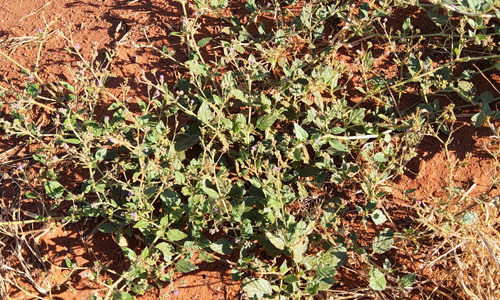
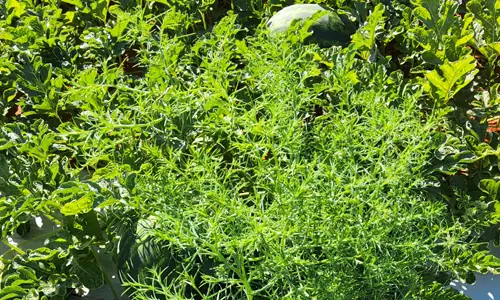
The goal was to identify key weed species causing problems under current production systems. During the visit, the most problematic weeds recorded were Pigweed (Portulaca oleracea), Tarvine (Boerhavia diffusa), Tick Weed (Cleome viscosa), and Roly Poly (Salsola australis.), all of which are known for their persistence and difficulty to control in crops under plastic mulch.
Identifying the key weed species in the Darwin, Katherine and Central Australia regions allows us to target weed suppression trials so they are directly relevant for local growers. A key focus of the project is understanding which weed species are able to persist through plastic mulch, as these weeds represent the greatest management challenge for growers.
The suppression trials will assess Anaerobic Soil Disinfestation (ASD). This is used overseas to manage weeds, soil-borne diseases, and nematodes. ASD works by incorporating an organic carbon source into the soil, followed by saturation with water, then covering it with plastic mulch to create anaerobic (low‑oxygen) conditions.
International research has shown that ASD can significantly reduce weed seed viability and pathogen loads. If proven effective under NT conditions and against local weed species, ASD could offer growers an additional non‑chemical weed management tool.
The next stage of the project will involve a series of pot trials to test the effectiveness of ASD against our key weed targets. These trials will also evaluate different mulch types (carbon sources) used in the process. Identifying suitable, locally available and cost-effective carbon inputs will be critical to ensure the practise can be adopted by growers.
Grower involvement is essential
If you are growing vegetables or melons under plastic mulch and are interested in understanding the dominant weeds on your farm, or in exploring alternative weed control options such as ASD, please get in touch. We are keen to work with growers to develop practical, on‑farm solutions suited to NT conditions.
Contact us
|
Alice Springs region: Shah Nawaz shah.nawaz@nt.gov.au |
Darwin region: Dakshina Yadav dakshina.yadav@nt.gov.au |
|
Katherine region: Jashan Kaur jashan.kaur@nt.gov.au |
Chelsea Moore chelsea.moore@nt.gov.au |