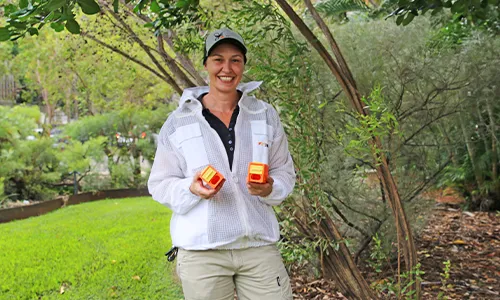
NT beekeepers build queen bee power
The Territory Government is backing the NT’s growing beekeeping industry, with a new specialist training initiative designed to strengthen local capability and reduce reliance on interstate imports.
Industry growth and government support
The NT beekeeping industry has seen steady growth in recent years, with registrations more than doubled since 2018.
There are currently 270 registered beekeepers managing 3,000 hives in the NT. Around 10 of these are commercial operators, each with more than 50 hives, collectively owning two‑thirds of all registered hives in the Territory.
Minister for Agriculture and Fisheries Gerard Maley said commercial beekeepers play a critical role in supporting pollination‑dependent crops across the Territory.
'Commercial beekeepers play a critical role in supporting pollination‑dependent crops, including melon production in the Katherine/Mataranka region, which contribute an estimated $70 million annually to the NT economy,' Mr Maley said.
Building local queen bee capability
Despite this growth, the NT currently has no commercial queen bee producers or breeders. Local beekeepers import approximately 2,000 queen bees and escorts each year under strict biosecurity controls.
To help build local expertise, the Department of Agriculture and Fisheries Plant Biosecurity team has partnered with NT Farmers to deliver queen bee artificial insemination training in Katherine from 27 February to 1 March 2026.
The training will be delivered by Kevin Tracy from BeeZone Apiaries, who previously delivered queen‑rearing workshops in Alice Springs, Katherine and Darwin in 2023.
'In our year of growth, certainty and security, this training is about building long‑term capability in the NT. Producing queens locally reduces biosecurity risk, strengthens hive health and gives NT beekeepers greater control,' added Mr Maley.
Artificial insemination offers an alternative to natural queen mating and colony propagation, addressing challenges such as uncontrolled genetics, loss of queens during mating flights and difficulty ensuring optimal mating conditions.
Importance for growers and future opportunities
NT Farmers Acting Chief Executive Officer Andrew Bourne said pollination underpins productivity for many Territory growers.
'Supporting beekeepers to produce queens locally helps protect biosecurity while supporting sustainable growth across agriculture,' Mr Bourne said.
'This protects against biosecurity threats and supply chain issues, ensuring a strong and healthy pollination industry which is so important to many NT growers.'
The training aims to reduce biosecurity risks associated with importing queen bees, build reliable production of high‑quality NT‑adapted queens, enable the selection of desirable genetic traits, support horticultural growth and strengthen the beekeeping sector for both commercial and hobbyist operators.
There are also future opportunities for NT beekeepers to export queens, nucleus colonies and hives to support interstate pollination shortages. This interstate trade will be possible as the NT implements regulatory changes made in 2024 to protect the pollination industry and bee hobbyists from varroa mite.
A new hive registration system and updated import requirements reinforce the NT’s strong biosecurity measures, which have been designed to ensure the NT remains varroa‑mite free.
The NT is a declared protected area for honey bees, with strict controls in place to prevent the introduction of pests and diseases.
More information
For more information on queen bee artificial insemination training, email honeybee@nt.gov.au.