Monitoring for arbovirus in NT cattle
The National Arbovirus Monitoring Program (NAMP) involves all states and territories of Australia and is jointly funded by governments and various livestock industries.
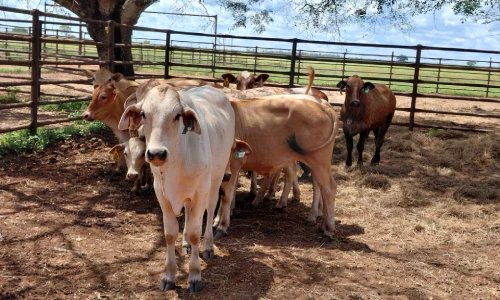
The core of the NAMP are the sentinel cattle herds and some commercial herds, from which blood samples are taken and around which midges are trapped.
The Top End of the Northern Territory is particularly important as it is the region of Australia where some insect vectors are thought to be introduced from Asia on monsoonal winds. This is how some insect-borne viruses (arboviruses) are introduced into the Australian mainland.
The vast majority of these viruses do not cause disease in humans or animals, but the potential is there for some to cause disease in livestock.
The viruses of interest are the bluetongue virus, bovine ephemeral fever virus and Akabane virus. These viruses have implications for trade in animals and animal products.
Bluetongue and Akabane viruses are transmitted by midges while ephemeral fever virus is transmitted mainly by mosquitoes.
Objectives of the NAMP:
- facilitate market access for the export of live ruminants and their reproductive material
- early warning for incursions of new bluetongue virus serotypes
- monitor arboviruses for risk management to support livestock production and trade.
The surveillance determines when and where these viruses are active, if there are any new variants of bluetongue present and which species of midges are active.
The sentinel herds are located at 5 main NT Government owned properties around the Northern Territory. NAMP also obtains samples from commercial cattle herds in key areas where bluetongue prevalence fluctuates (generally in the southern arid regions).
Blood samples are taken from the cattle for testing at the Berrimah Veterinary Laboratory. Midges are caught in light traps and are identified and counted by entomologist employed by the Northern Australian Quarantine Strategy.
The data is uploaded into a national database where it can be interrogated, together with data from other states.
NAMP in the Northern Territory is made possible by the commitment, dedication and collaboration of a large team with diverse expertise from many different sectors of government.