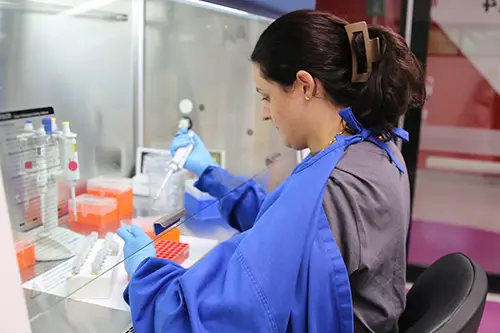
Molecular diagnostics at the Berrimah Veterinary Laboratory
The Berrimah Veterinary Laboratory (BVL) provides accredited diagnostic and surveillance services to support animal health and Australia’s biosecurity, through molecular testing for significant endemic and exotic diseases.
To address emerging biosecurity threats and rapidly evolving molecular technologies, BVL hosts the NABSeq high‑throughput sequencing facility, enhancing future diagnostic capability through advanced genomic and metagenomic applications.
Diagnostic services and operating environment
The BVL delivers comprehensive diagnostic and surveillance services to animal production industries, companion animals and wildlife from rural and remote regions of Australia. These services are provided within an operating environment characterised by:
- a persistent moderate to high risk of animal disease incursions along Australia’s remote northern borders
- the potential emergence of previously undescribed animal diseases
- rapid advances in diagnostic technologies, and the imperative for effective communication and collaboration with veterinary and scientific experts across Australia.
BVL undertakes veterinary testing of production animals, including:
- aquaculture species
- to support diagnostic
- surveillance
- monitoring
- regulatory
- research
- export certification
- exotic disease exclusion activities.
Molecular diagnostics and priority pathogens
The molecular diagnostics section at BVL conducts PCR‑based analyses for animal disease diagnosis and surveillance in accordance with national accreditation standards.
In alignment with Australia’s biosecurity objectives, testing is performed for a range of significant pathogens, including:
- bluetongue virus
- hendra virus
- Japanese encephalitis virus
- avian influenza virus.
The fields of molecular and genomic testing are rapidly evolving, necessitating continual updates to knowledge, methodologies and procedures to maintain compliance with international standards. In response, a project was initiated to:
- establish a collaborative high‑throughput sequencing (HTS) facility and network, known as the NABSeq facility and network
- support Australia’s biosecurity interests in northern Australia.
The NABSeq project is based at BVL.
Future capabilities
Future enhancements in diagnostic capability are anticipated to increasingly rely on the diverse, rapid, highly sensitive and highly specific applications of HTS technologies.
These include:
- the detection of novel, exotic or emergency disease pathogens in complex samples
- use of metagenomic (environmental DNA)to identify trace levels of pathogens in environmental matrices such as water
- application of metabarcoding techniques to simultaneously identify multiple organisms within a single sample, including exotic insect vectors.
To learn more, including how to submit samples for testing, read Berrimah Veterinary Laboratory.