From innovation to impact: NT’s Climate-Smart Agriculture project successfully concluded
The Northern Territory Department of Agriculture and Fisheries (DAF) has successfully concluded a two-year project aimed at increasing the adoption of Climate-Smart Agriculture (CSA) practices to improve soil health, water use efficiency, and drought resilience among horticultural growers.
Led by DAF’s Senior Research Horticulturalist in Central Australia, Shah Nawaz, the project focused on building soil organic matter in sandy soils—an approach designed to enhance productivity and sustainability in the face of climate change.
'The project demonstrated measurable improvements in soil health, water use efficiency, and climate resilience among horticultural growers in central Australia,' Mr Nawaz said.
'The implications are far-reaching, as widespread adoption of CSA practices could support more sustainable and resilient farming systems across Australia.'
Project focus and objectives
The project, titled 'Increasing Adoption of Climate-Smart Agricultural Practices with a Focus on Building Soil Organic Matter and Water Use Efficiency,' was designed to:
- promote the adoption of CSA techniques in the horticultural sector
- improve drought resilience and soil fertility
- enhance water use efficiency in the Northern Territory’s challenging agricultural environments.
Climate change, combined with inherently poor soils and historically low uptake of sustainable practices, presents ongoing challenges for growers - particularly in remote and arid parts of the NT.
Phased approach and on-ground engagement
The project was delivered in 4 key phases:
- Benchmarking – assessing current practices and soil conditions.
- Demonstrating – establishing demonstration sites to trial CSA practices.
- Co-learning – engaging growers through field days and workshops; and
- Incentivising – encouraging grower-led adoption of successful methods.
Field activities included the setup of two demonstration sites and two adoption sites, along with the delivery of three field days and several workshops.
Key engagement activities
- May 2023 – Climate-Smart Agriculture workshop, Arid Zone Research Institute (AZRI)
- December 2023 – Field Day at Desert Farms demonstration site, Ali Curung
- March 2024 – Field Day at Oolloo Farms demonstration site, Ti-Tree
- February 2025 – Field Day at Centrefarm adoption site, Ali Curung
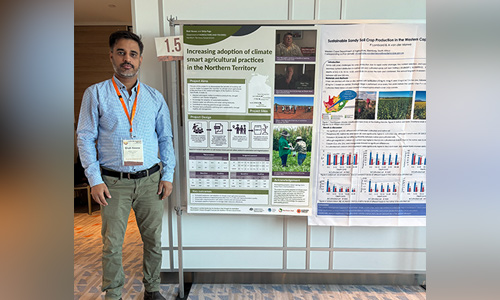
- July 2025 – Presentation at the 2nd Global Conference on Sandy Soils, Shifting Sands to Sustainable Solutions, Perth, Western Australia
These events provided critical opportunities for growers, researchers, and extension officers to collaborate, share knowledge, and build confidence in CSA adoption.
Collaboration and funding
The project was supported by the Northern Hub, with funding from the Australian Government’s Future Drought Fund, and delivered by the NT Department of Agriculture and Fisheries.
Looking ahead
The success of this project demonstrates the potential for climate-smart agricultural practices to transform farming systems across Australia, especially in regions facing harsh climatic and soil conditions.
With improved soil health, increased resilience to drought, and more efficient water use, CSA practices can play a pivotal role in supporting long-term agricultural productivity and environmental sustainability.