

Vet News NT: February 2026
Message from the chief veterinary officer
2025 was a busy year for the Livestock Biosecurity team, including the Berrimah Veterinary Laboratory.
While there are many highlights, and some of these are covered in further stories in the newsletter, including an article on melioidosis, it is worth noting the significant work that is going on within the government to prepare for emergency animal diseases (EAD).
A lot of activity took place in preparing for high pathogenicity avian influenza (HPAI), especially with the current H5 subtype that is circulating.
While the NT does not have a commercial poultry industry, the current pattern for H5 HPAI has been to decimate wildlife populations in certain countries.
The NT Livestock Biosecurity team has worked with other agencies across the NT Government, including environment and health, to plan and coordinate a response, should H5 HPAI arrive on Australia's mainland.
In May 2025, the NT Livestock Biosecurity team led exercise raintree that included 3 state or territory control centres for NT, WA and QLD operating separately at the same site.
The exercise brought together 41 people from the Australian, NT, QLD and WA governments and northern livestock industry associations to improve Australia’s EAD preparedness and coordination.
The focus of raintree was to enhance capacity and strengthen preparedness and response capabilities for managing EAD incursions in northern Australia, including foot-and-mouth disease and lumpy skin disease (LSD). The exercise was based on an LSD scenario and had a key objective of testing interoperability between jurisdictions.
In October 2025, I was fortunate enough to accompany the Hon Gerard Maley MLA, for Minister for Agriculture and Fisheries, on his first trip to Indonesia.
As part of a delegation that included government and industry, we were able to see first-hand Australian cattle in feedlots in Indonesia and gain a better understanding of the key drivers for protein for our most important trading partner.
In addition, we got to practice our strict biosecurity procedures, including staying away from livestock for seven days on our return!
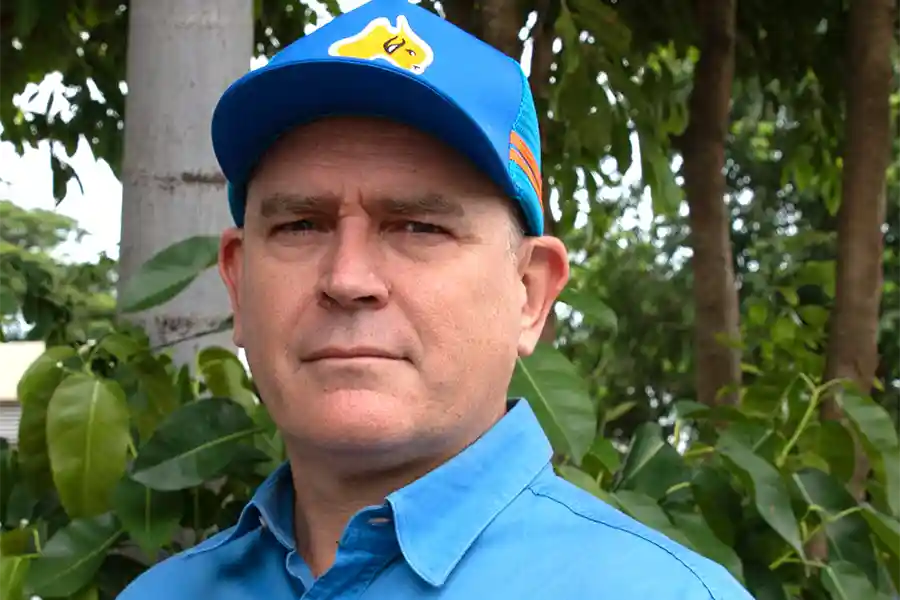
Chief Veterinary Officer, Rob Williams
Regional veterinary officer - Katherine commences
Dr Storm Scheepers recently commenced as the regional veterinary officer for the Katherine region. He grew up in the wilds of Africa and has always shared a love and keen interest in all animals great and small.
Dr Scheepers obtained his Bachelor of Veterinary Biology in 2011 followed by a Bachelor of Veterinary Science in 2015 from the University of Pretoria in South Africa.
Since then, he has travelled and worked in different countries across Africa as well as spending some time working in New Zealand and now Australia. He enjoys all facets of being a veterinarian and has worked in different veterinary roles. He has experience working in welfare, mixed animal practice and most recently small animal practice.
When Dr Scheepers isn’t working, you’ll find him outdoors seeking the next thrill and adventure. He recently got his fixed wing pilots license and loves his fishing, hiking, camping and scuba diving.
Dr Scheepers is looking forward to doing his absolute best using his veterinary skills to function as a member of the Livestock Biosecurity team to protect and enhance the health, welfare and marketing of livestock throughout the Katherine region and the NT.
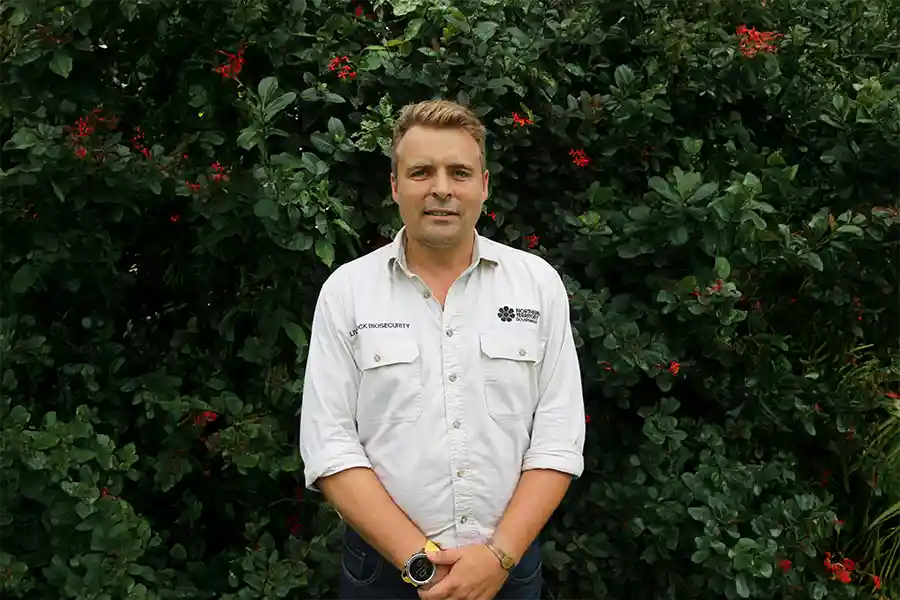
Dr Storm Scheepers
Welcome director of Berrimah Veterinary Laboratory
Dr Joan Lloyd, DVM MVS, Veterinary Pathology PhD, recently joined the Berrimah Veterinary Laboratory (BVL) in the role of director. Dr Lloyd has extensive experience working in a veterinary laboratory, having previously worked for the NSW Government and establishing a private research laboratory.
Dr Lloyd is a highly experienced veterinary leader with a track record of successful project delivery across the livestock industry, government, academia, and the private sector. She has extensive experience leading livestock health and welfare, biosecurity, research, surveillance and disease control programs and projects.
In her role as director of BVL, Dr Lloyd will focus on leading BVL to continue to become a high-technology, cutting edge laboratory that has key capacity in emergency animal disease diagnostics.
The Department of Agriculture and Fisheries is pleased to welcome Dr Lloyd to BVL.

Dr Joan Lloyd
Molecular diagnostics at the Berrimah Veterinary Laboratory
The Berrimah Veterinary Laboratory (BVL) provides accredited diagnostic and surveillance services to support animal health and Australia’s biosecurity, through molecular testing for significant endemic and exotic diseases.
To address emerging biosecurity threats and rapidly evolving molecular technologies, BVL hosts the NABSeq high-throughput sequencing facility, enhancing future diagnostic capability through advanced genomic and metagenomic applications.
The BVL delivers comprehensive diagnostic and surveillance services to animal production industries, companion animals, and wildlife from rural and remote regions of Australia.
These services are provided within an operating environment characterised by a persistent moderate to high risk of animal disease incursions along Australia’s remote northern borders, the potential emergence of previously undescribed animal diseases, rapid advances in diagnostic technologies, and the imperative for effective communication and collaboration with veterinary and scientific experts across Australia.
BVL undertakes veterinary testing of production animals, including aquaculture species, to support diagnostic, surveillance, monitoring, regulatory, research, export certification, and exotic disease exclusion activities.
The molecular diagnostics section at BVL conducts PCR-based analyses for animal disease diagnosis and surveillance in accordance with national accreditation standards. In alignment with Australia’s biosecurity objectives, testing is performed for a range of significant pathogens, including bluetongue virus, Hendra virus, Japanese encephalitis virus, and avian influenza virus.
The fields of molecular and genomic testing are rapidly evolving, necessitating continual updates to knowledge, methodologies, and procedures to maintain compliance with international standards.
In response, a project was initiated to establish a collaborative high-throughput sequencing (HTS) facility and network, known as the NABSeq facility/network, to support Australia’s biosecurity interests in northern Australia. The NABSeq project is based at BVL in Darwin.
Future enhancements in diagnostic capability are anticipated to increasingly rely on the diverse, rapid, highly sensitive, and highly specific applications of HTS technologies. These include:
- detection of novel, exotic, or emergency disease pathogens in complex samples
- metagenomic (environmental DNA) approaches for identifying trace levels of pathogens in environmental matrices such as water
- metabarcoding applications capable of simultaneously identifying multiple organisms within a single sample, including exotic insect vectors.
To learn more and submit samples for testing, read Berrimah Veterinary Laboratory.
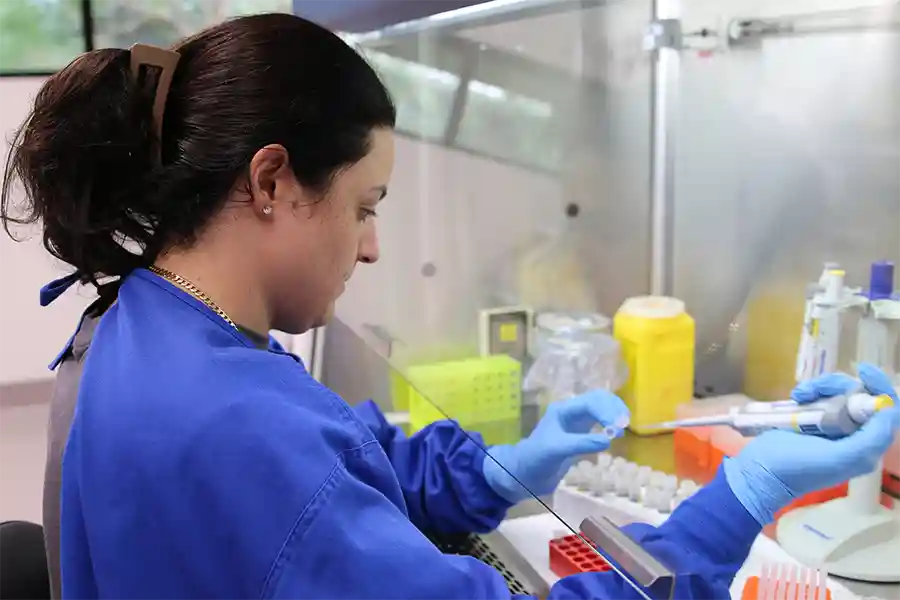
The Berrimah Veterinary Laboratory - Project Scientist, Maria Mpilias conducting DNA extraction in the laboratory.
Animal melioidosis in the NT
Melioidosis is a serious endemic disease of animals that occurs in tropical Australia, mainly in the wet season.
Melioidosis is a disease caused by infection with the bacterium Burkholderia pseudomallei. The disease is endemic in south-east Asia and northern Australia, with the greater Darwin region being the area in Australia where the disease is most common.
The bacterium can cause serious disease in both animals and humans but is not considered a zoonosis, disease that is transmitted from animals to humans. But rather, both animals and humans become infected by exposure to soil. B. pseudomallei requires moisture to survive, and in the dry season is located deep in soil. Exposure to the bacterium, and thus potential for disease occurs mainly in the wet season in animals that are present in muddy conditions, have access to standing water or are outside in wet, windy weather.
Infection may occur through skin wounds, inhalation or ingestion. The bacteria can then gain access to the bloodstream from the primary site of infection to result in a wide variety of lesions and clinical signs. There are significant animal species differences in susceptibility to infection.
Among farm animals in the NT, goats are the most susceptible, with the disease being rare in cattle and horses. In goats, abscesses in the liver or spleen are common, along with pneumonia, joint infection, infection of the bone of the lumbar vertebra or the brain.
Dogs and cats are considered moderately susceptible to infection.
In dogs, skin infections and fever are relatively common presentations while in cats, respiratory infection and occasionally severe eye infections are notable. In both dogs and cats, the disease may present as primarily nervous signs, which carry a very poor prognosis.
Infection is diagnosed by culture of infected tissue or exudate. Successful treatment requires intense, long-term antibiotic administration for weeks to months. Melioidosis in animals is notifiable in the NT.
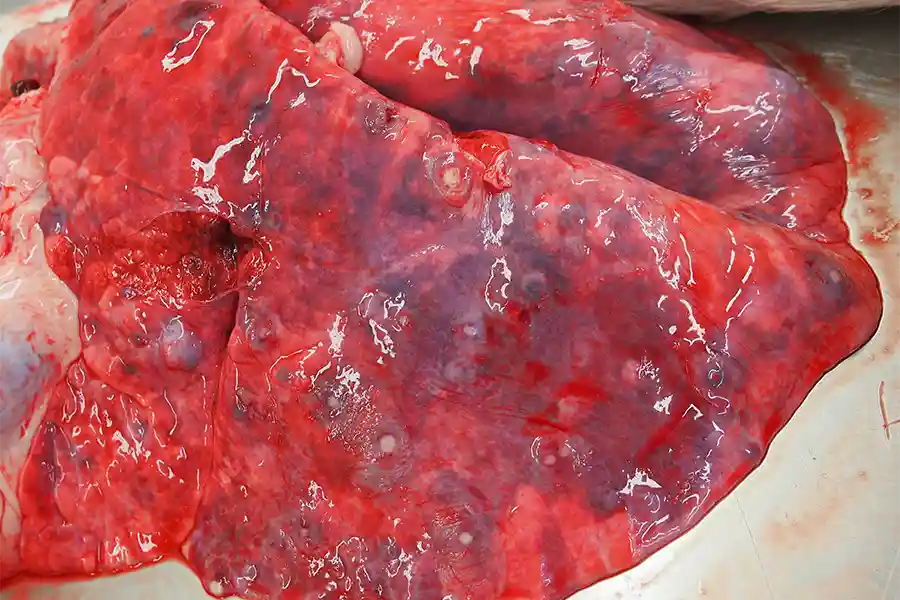
Lungs of goat with melioidosis. Throughout the lungs, there are multiple red congested areas with central white zones of pus. The pattern of the lesions throughout the lungs reflects spread of the bacteria through the bloodstream.
Opening of core skills occupations list consultation
The 2026 Occupations List (OSL) Stakeholder Survey is now open. The survey is run by Jobs and Skills Australia (JSA).
The OSL provides a detailed view of occupations in shortage in Australia and informs potential policy responses to address shortages in the Australian labour market, including visa and training programs. Ratings from the final OSL may also influence the next update of the core skills occupation list and the Australian apprenticeships priority list.
Consultation is open until 5 pm Wednesday 18 March 2026.
We encourage your organisation to participate in the consultations by completing a survey through the JSA website. Your insights will help government better understand the recruitment challenges and ensure the next occupation shortage list accurately reflects your industry’s current position and any identified gaps in skills, training, and/or workforce.
For more information on how to participate, go to the Australian Government’s JSA website.
Contact us
Veterinary Board registrar
Phone: 08 8999 2028
Fax: 08 8999 2089
First floor John England Building
Berrimah Farm
Makagon Road
Berrimah NT 0828
GPO Box 3000
Darwin NT 0801
Give feedback about this page.
Share this page:
URL copied!